Industry Intelligence & Intent Analysis Future Procurement Trends in Custom Embroidered Club Crest Manufacturing
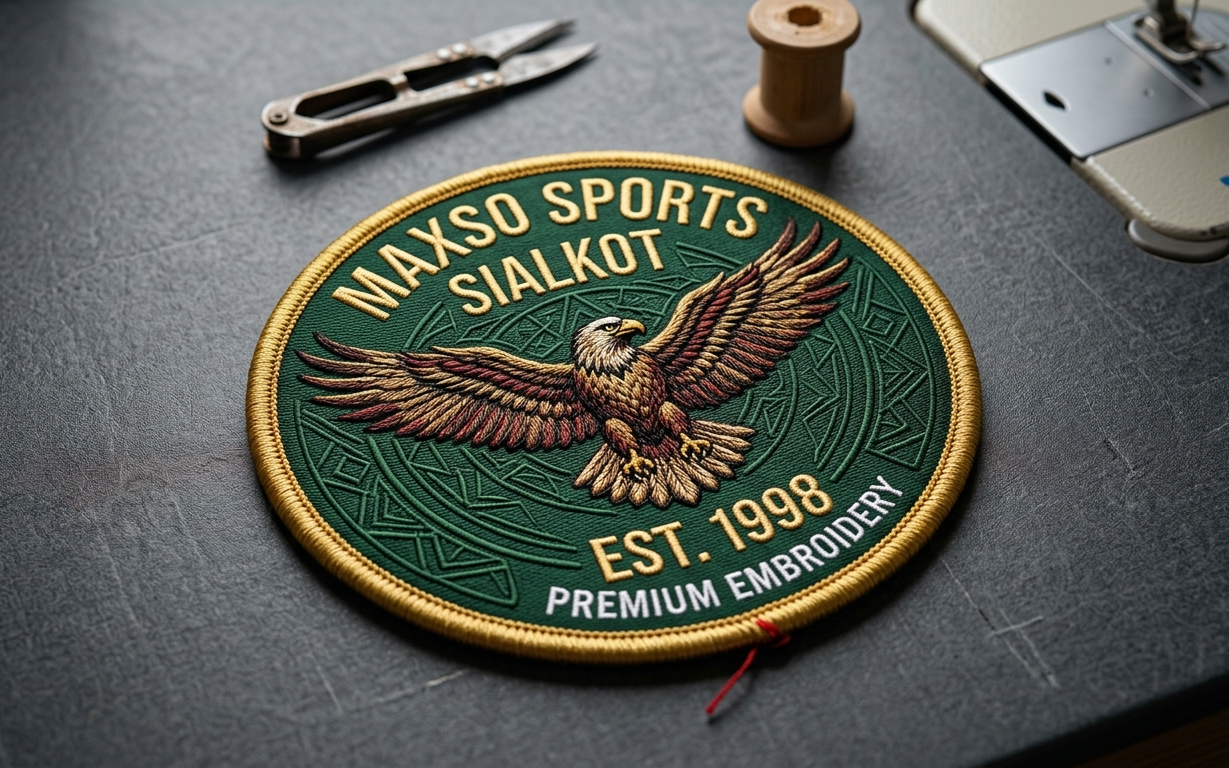
The global athletic badge and sports emblem procurement landscape is undergoing significant technological and operational evolution. Buyers sourcing custom embroidered club crests in 2026 and beyond must navigate shifting environmental regulations, advanced garment integration requirements, and digitized supply chain expectations. As a factory-direct OEM in Sialkot, Pakistan, Maxso Sports identifies four major macro trends shaping bulk crest purchasing:
1. Transition to Eco-Friendly Recycled Threads and Non-PVC Backings
Global sports governing bodies and European apparel brands are instituting stringent eco-design directives. Environmental compliance now requires badge components to align with circular textile standards. Standard virgin polyester threads are rapidly being replaced by GRS-certified (Global Recycled Standard) recycled polyester embroidery yarns derived from post-consumer PET bottles. Furthermore, legacy PVC heat-seal backings are being phased out in favor of eco-friendly TPU (Thermoplastic Polyurethane) and biodegradable hot-melt adhesive films that retain high bonding strength without releasing toxic phthalates during high-temperature heat pressing.
2. Lightweight Integration with Micro-Fine Performance Fabrics
Modern match kits use ultra-lightweight, 120-140 GSM moisture-wicking polyester meshes designed for elite athlete breathability. Traditional heavy embroidered badges often cause shirt drag, skin abrasion, and fabric puckering. To overcome this, the industry trend favors micro-density embroidery digitizing paired with laser-cut edge finishing. By reducing underlying stitch fill density while maintaining top-layer visual vibrancy, manufacturers achieve a 35% weight reduction per crest, allowing seamless application onto stretchable, lightweight performance garments.
3. Digital Twin Digitizing and Rapid AI-Driven Prototyping
Procurement teams no longer accept 3-4 week sampling cycles for custom crest physical iterations. The adoption of advanced CAD software (such as Wilcom, Tajima DG/ML) allows Maxso Sports to generate photorealistic 3D digital thread simulations and vector stitch previews within 24 hours. B2B buyers can inspect thread direction, sheen, density, and backing boundaries before physical needles strike fabric, eliminating sample rejection cycles and compressing production timelines by up to 50%.
4. Smart Crest Integration (Anti-Counterfeiting & NFC Embedding)
Merchandising security is critical for professional sports franchises facing global counterfeit distribution. Modern custom embroidered club crests are increasingly embedded with ultra-thin, washable passive NFC (Near Field Communication) chips or micro-woven RFID tags encapsulated between the backing film and embroidery felt. This provides fan engagement opportunities via smartphone scans while granting brand protection teams instant supply chain verification at retail locations.
 Classic Matchwear